
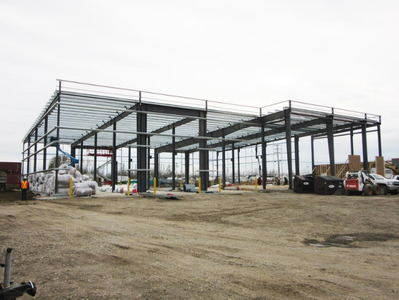
Based on robust demand resulting from government spending on infrastructure development and industry capital expenditure (capex), pre-engineered building (PEB) manufacturers in the nation are expected to witness revenue growth of 10–12% in FY25 and the following fiscal year, according to a report released on Wednesday.
Given their advantages in terms of time and cost, PEB structures have become the go-to option for industrial and infrastructure buildings, according to a Crisil Ratings analysis.
The need for PEB structures will be driven by a variety of uses in a variety of sectors, including railways (yards, portions of stations), roadways (toll plazas), and airports (hangars, terminal buildings), among others. This need will be supported by an increase in government infrastructure spending.
Because less steel and labor are needed, these buildings can be installed in 40–50% less time than traditional constructions, often at a significant cost reduction.
According to the report, this is driving up demand for PEB structures in addition to other advantages including their highly recyclable materials and modular design.
Anand Kulkarni, Director of CRISIL Ratings, states that for the next two fiscal years, industrial capital expenditure (capex), which makes up around half of PEB demand, should continue to be strong.
Demand will also be fueled by PEB’s increasing penetration because it is less expensive than traditional constructions. Warehouse and logistics parks have emerged as the major sector within the industrial sector, according to Kulkarni. He added that growth in this sector is expected to be robust over the next few years, supported by the rise of logistics players and e-commerce.
“The capacity utilisation of the PEB players stood healthy at more than 70 per cent in fiscal 2024 backed by strong demand,” said Prateek Kasera, Team Leader, CRISIL Ratings. “The PEB players’ revenue growth is constrained by optimal capacity utilisation, hence the industry is witnessing capacity addition.” “To capitalise on demand, PEB players are incurring capex,” Kasera added. “The industry capacity is expected to grow 20 per cent by the end of the next fiscal over fiscal 2024.”
