
27 JUL 2025, New Delhi
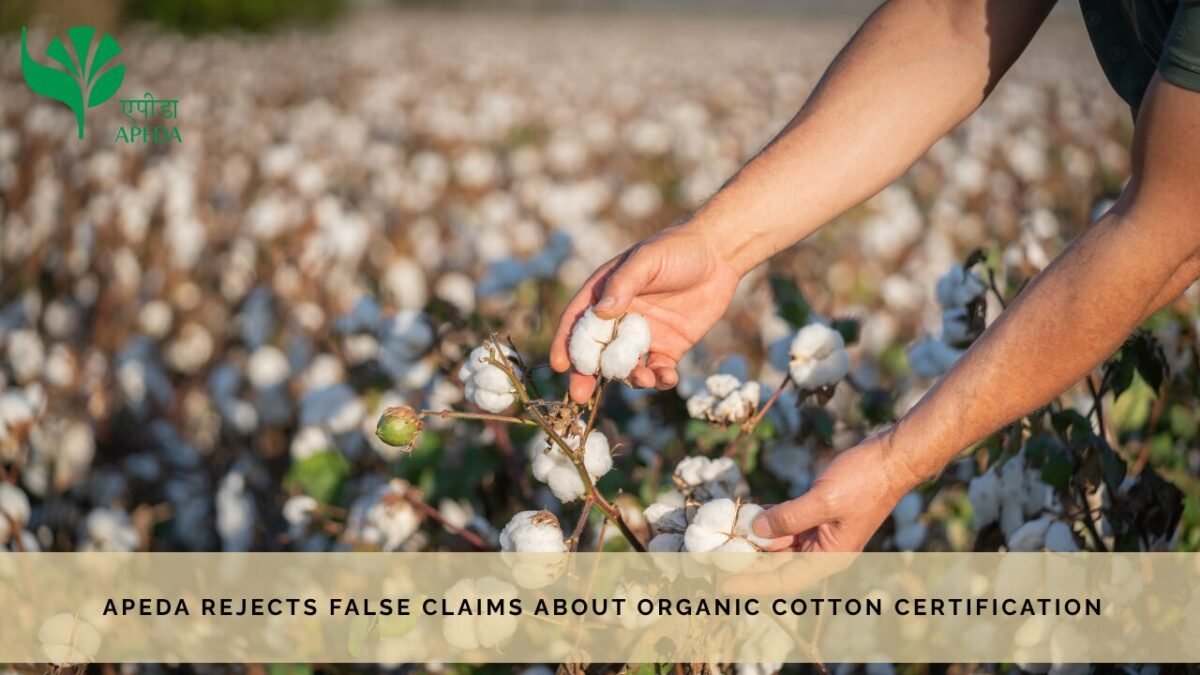
The Agriculture & Processed Food Products Export Development Authority (APEDA) has strongly denied recent allegations made against India’s organic cotton certification system. The government body clarified that these claims are misleading and incorrect, and that India’s organic certification process is strict, well-monitored, and internationally accepted.
The Agriculture and Processed Food Products Export Development Authority (APEDA) has strongly denied the recent allegations made against India’s organic certification system, especially concerning organic cotton. The claims were made during a press briefing by an opposition leader on 26 July 2025.
In a statement, APEDA clarified that the National Programme for Organic Production (NPOP) follows a strict third-party certification process that is internationally recognized and transparent.
Organic Certification Process Explained
The NPOP was launched in 2001 by the Department of Commerce, Ministry of Commerce & Industry to promote organic exports. APEDA serves as the implementing agency.
According to the official release:
- Third-party certification is mandatory for all organic exports.
- The NPOP standards are accepted by the European Commission, Switzerland, Great Britain, and Taiwan.
- There are currently 37 active Certification Bodies in India, including 14 State Certification Bodies, that certify farmers and their produce.
No Subsidy Under NPOP
APEDA clarified that no financial subsidy, such as the falsely claimed Rs 50,000 per hectare is provided to farmers under the NPOP. The calculation shared in the briefing was said to be baseless and misleading.
Nationwide Coverage, Not Just Cotton
Refuting the claim that organic certification is limited to Madhya Pradesh and focused only on cotton, APEDA provided the following data:
- As of 19 July 2025, there are 4,712 active organic grower groups across 31 States and Union Territories.
- These groups include around 19.29 lakh certified farmers.
- Certified crops include cereals, pulses, oilseeds, tea, coffee, and spices, not just cotton.
It was further clarified that cotton certification under NPOP ends at the production stage. Further processing like ginning and spinning is carried out under private certification systems.
Strict Monitoring and Action Against Violations
The NPOP system involves multiple layers of monitoring:
- Internal Control Systems (ICS) must inspect farmers twice a year.
- Certification Bodies carry out annual audits of grower groups.
- Unannounced inspections are conducted by APEDA and the National Accreditation Body (NAB) based on risk assessments or complaints.
APEDA stated that despite a strong system, incidents of malpractice have been reported. However, strict action has been taken in such cases, including:
- Cancellation of certifications of violators.
- Revised NPOP regulations for tighter checks and inspections.
- Launch of mobile app-based inspection systems.
- Additional controls for organic cotton certification, including limiting certification zones.
Call for Responsible Statements
APEDA stressed that generalised allegations against the NPOP system harm the credibility of India’s regulatory framework and undermine the efforts of genuine organic farmers. They urged all stakeholders to avoid spreading misinformation and instead support a transparent and trustworthy certification process.
“The NPOP certification system is built on strict rules, international standards, and transparent inspections. Any complaint received is thoroughly investigated, and action is taken as per law,” APEDA said in its statement.
Source: PIB
